
Find out when bar-fed CNC turning in Melbourne suits repeat precision parts, and what to send Aero Spec Engineering so your drawing can be assessed.
Repeat orders expose weak machining control quickly, from inconsistent stock positioning to handling between cycles. Bar-fed CNC turning in Melbourne can suit round components made in volume, and at Aero Spec Engineering we check the drawing, quantity and material before recommending a production route.
What Is Bar-Fed CNC Turning in Melbourne Used For?
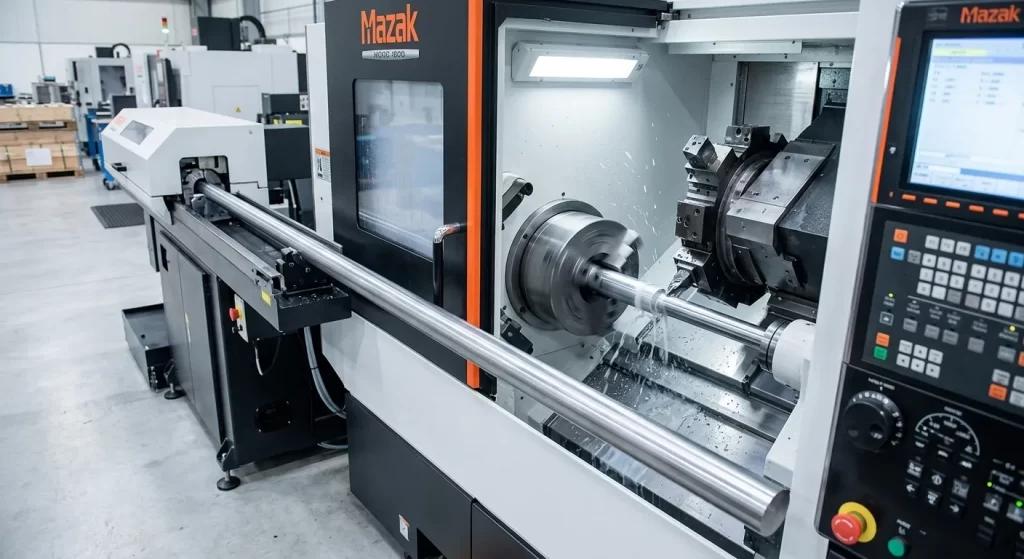
Bar feeding moves bar stock into the lathe for successive machining cycles. For suitable parts, this can reduce manual loading and support steadier cycle control across an approved batch. Part geometry, bar diameter, material behaviour and order volume still decide whether the method makes commercial sense.
Our CNC multi-axis turning covers both high and low volume work at our Clayton South workshop, and our machinery page lists two Mazak Quick Turn Nexus lathes as Rapidfeed models. Whether a particular part runs bar-fed depends on its size, material and the lathe, so we confirm that when we review your drawing. Tolerances and inspection needs are also checked against the drawing before production begins.
Where Bar-Fed Turning Adds Value
The strongest candidates have compatible bar stock and repeatable geometry. Look at the whole production requirement, not just the lowest unit price.
- Repeat quantities: Stable programs can reduce handling across suitable production runs.
- Consistent stock: Controlled bar size and material condition support predictable cutting and workholding.
- Round-bar geometry: Shafts, bushes, pins and spacers are typical candidates, although every drawing still needs review.
- Drawing-led tolerances: Specified limits guide tooling, cycle planning and inspection without adding precision the part does not need.
- Inspection requirements: Agreed checks give clear acceptance points for the first piece and the production batch.
Parts that need milling, grinding or EDM after turning are worth raising early. We can review those features together, which may cut the number of hand-offs between suppliers.
Planning a Stable Repeat-Part Program
Accurate quoting starts with a current drawing and clear production details. We review the material, tolerances, finish, quantity and delivery target before choosing bar-fed CNC turning in Melbourne or another route. That check flags costly features early, before production planning begins.
Tool condition, stock control and agreed inspection points all affect whether a batch stays within its specification. Our machinery and CMM capability supports dimensional checks where they are required, and our article on CMM inspection reports for CNC machined parts explains what pre-production approval can involve. Safe bar handling matters as well. WorkSafe Victoria’s guidance on safe use of metal turning lathes recommends using a bar feeder system or support stands to secure bar that protrudes during machining.
Request an Assessment of Your Repeat-Part Drawing
Bar-fed CNC turning in Melbourne can work well for suitable repeat components, but only after geometry, stock and inspection needs are confirmed. Our precision engineering services also include milling, grinding and EDM, so we can look at related features in the same review.
Contact us with your current drawing, material grade, order quantity and delivery target. Telling us whether the part is a one-off sample or an ongoing program also helps us judge the right production route, and we will flag any missing specifications before moving towards a quote.
Optimized by: Netwizard SEO
